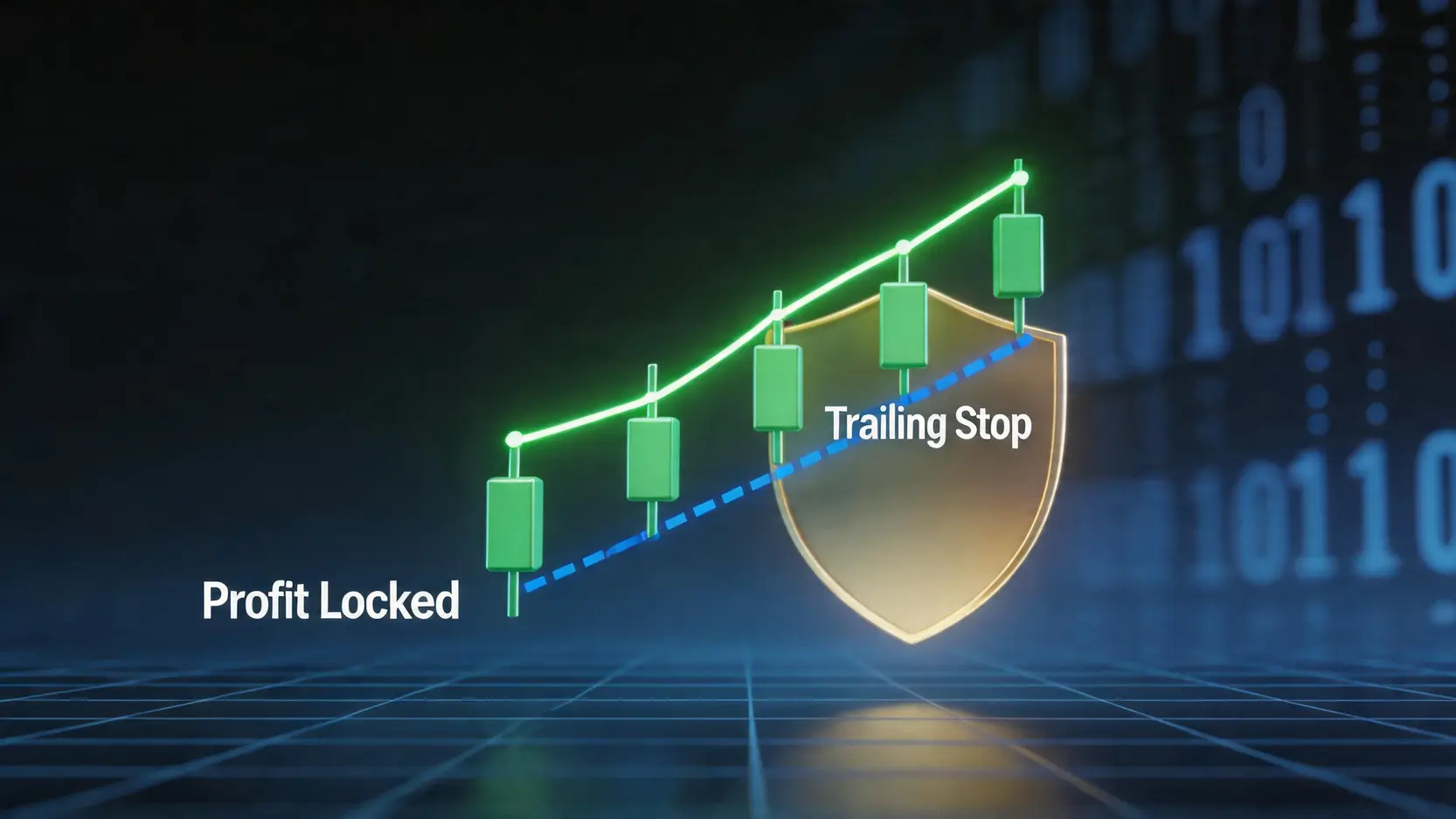
The Theoretical Background and Cross-Market Logic of Trailing Stops
Trailing stops are widely used in forex trading not because they can predict future prices, but because they convert “loss control” and “profit drawdown management” into a set of executable price rules. A standard stop loss addresses the maximum loss boundary after entry, while a trailing stop further addresses how to dynamically adjust the exit level after the price moves in a favorable direction.
In a trading system, a trailing stop is an exit mechanism, not an entry signal. Its core idea is: when the market has not yet proven the trading judgment wrong, allow the position room to continue running; when the price pullback reaches a preset threshold, use rules to close the trade. This mechanism is particularly aligned with trend trading, because trend strategies usually accept small losses and repeated trial-and-error while relying on a few longer trends to contribute the main results.
From the history of technical analysis, the idea of trailing stops is closely related to trend-following methods.Dow Theoryemphasizes that markets have primary trends, secondary trends, and short-term fluctuations, and believes that trends tend to continue until a clear reversal is confirmed. In the late 20th century, J. Welles Wilder introduced tools such as Average True Range and Parabolic SAR inNew Concepts in Technical Trading Systemsin 1978, making the idea of “setting dynamic exits based on volatility and price structure” more systematic.
A Trailing Stop Is Not a Profit Target, but a Dynamic Risk Boundary
A common misunderstanding in original trading texts is to interpret a trailing stop as “not needing to manually adjust the profit target.” A more accurate statement is that a trailing stop adjusts the stop-loss level, not the take-profit level. A take-profit order is usually used to close a position at a preset price; a trailing stop is used to exit a position when the price retraces by a certain amount. The two can exist at the same time, but their functions are different.
For example, a trader opens a long position at 1.3400 and sets a 50-pip trailing stop. If the price rises to 1.3470, the stop loss can move to 1.3420. At this point, the position may still remain open because there is no fixed take-profit limiting the upside; but if the price falls back to the stop-loss level, the system will trigger an exit. This reflects the principle of “leaving room for favorable movement while using rules to constrain adverse pullbacks.”
| Comparison Dimension | Key Parameter | Applicable Scenario | Main Risk |
|---|---|---|---|
| Trailing stop | Fixed pips, percentage, or ATR multiple | Trend continuation and floating profit protection | Easily triggered by price noise in range-bound markets |
| Take-profit order | Fixed target price or risk-reward target | Range trading and planned exits | May close trend positions too early |
| Breakeven stop | Entry price or price after covering the spread | Reducing risk after the price has moved a certain distance | Moving to breakeven too early may reduce the strategy’s margin for error |
| Manual close | Human judgment, event changes, or rule triggers | Around major news or when strategy conditions fail | Execution is easily affected by emotions |
Forex Pips, Quote Precision, and Calculation Basics
In forex trading, trailing distance is usually expressed in pips. For most non-JPY currency pairs such as EUR/USD, GBP/USD, and AUD/USD, 1 pip is usually 0.0001; for JPY-related currency pairs such as USD/JPY and EUR/JPY, 1 pip is usually 0.01. If a platform uses five-digit quotes, the smallest quote unit may be 0.00001; if a platform uses three-digit JPY quotes, the smallest unit may be 0.001. In this case, the smallest unit is often called a point, and 10 points equal 1 pip.
Therefore, when discussing trailing stops, both the quote convention and pip value must be specified. Taking EUR/USD as an example, a standard lot is 100,000 base currency units, and the value of 1 pip is usually about USD 10; a mini lot is 10,000 units, and the value of 1 pip is usually about USD 1; a micro lot is 1,000 units, and the value of 1 pip is usually about USD 0.10. If the account currency is not USD, or if the traded instrument is a cross pair, the pip value needs further conversion.
First confirm the quote digits of the currency pair, such as 1.3400 or 1.34000 for EUR/USD.
Then confirm whether the trailing stop unit in the platform settings is pip, point, or price distance.
Calculate the account currency amount corresponding to each pip.
Multiply the stop-loss distance by the value per pip to obtain the risk amount per lot.
Work backward from account equity and the single-trade risk ratio to determine the usable position size.
Trailing Stops and Trend-Following Theory
Trend following does not seek to exit at the exact highest or lowest point every time, but attempts to capture a directional market move through rules. A trailing stop serves the exit function within this framework. It allows traders to continue holding when the trend has not been clearly broken, and to exit after the pullback exceeds a preset standard. This logic is close to the idea inDow Theorythat “a trend continues until a reversal is confirmed,” and is also connected to later breakout trading, volatility stops, and channel exit methods.
Average True Range, orATR, introduced by J. Welles Wilder, is often used to measure market volatility. True range usually takes the largest of the following three values: the current high minus the current low, the absolute difference between the current high and the previous close, and the absolute difference between the current low and the previous close. ATR is the smoothed result of true range. Traders often use 1 to 3 times ATR as a dynamic stop-loss distance to avoid being triggered too early in high-volatility environments.
| Comparison Dimension | Key Parameter | Applicable Scenario | Main Risk |
|---|---|---|---|
| Fixed-pip trailing stop | 20 to 100 pips | Major currency pairs with stable volatility | Cannot automatically adapt to expanding volatility |
| ATR trailing stop | 1 to 3 times ATR | Trading environments with clear volatility changes | Improper ATR period settings may distort the distance |
| Parabolic SAR | Common step of 0.02 and maximum value of 0.20 | Markets with relatively clear one-sided trends | May generate frequent whipsaw signals during sideways phases |
| Channel exit | 10-day, 20-day, or 55-day highs and lows | Short- to medium-term trend following and breakout systems | Sensitive to false breakouts and pullbacks |
Cross-Asset Comparison: Forex, Stocks, Futures, and Contracts for Difference
Trailing stops are not unique to the forex market. Similar mechanisms can also be used in stocks, futures, indices, andCFD, but different instruments have different quote units, trading hours, gap risks, and liquidity structures.
The spot forex market usually has longer trading hours, and major currency pairs tend to have high liquidity during active sessions, but major macroeconomic data, central bank interest rate decisions, or geopolitical events can still cause rapid volatility. Stock markets have exchange opens and closes, where overnight gaps are more common. Futures markets involve contract expiry, margin adjustments, and trading-hour limits. CFDs also involve market-maker pricing, overnight financing, and differences in platform rules.
Forex trailing stops often use pips as the core unit and are suitable for evaluation together with spreads, slippage, and volatility.
Stock trailing stops are often set by price amount or percentage, such as 2%, 5%, or 10%.
Futures trailing stops need to consider minimum tick size, contract multiplier, and exchange margin.
CFD trailing stops need to consider platform execution rules, financing costs, and forced liquidation mechanisms at the same time.
Platform Execution and Order Trigger Mechanisms
The actual effectiveness of a trailing stop is closely related to platform execution rules. Some platforms store trailing logic on the server side, while others require the client terminal to remain running. If the trailing stop depends on the local terminal, the trailing logic may stop updating when the trader closes the software, the computer enters sleep mode, or the network disconnects, but the last standard stop-loss level already submitted to the server will usually remain in place.
In addition, different platforms may define “activation” differently. Some platforms allow traders to set an initial stop loss and begin tracking at the same time when opening a position; others only start moving or establishing the stop-loss level after the price has moved a specified distance in the favorable direction. Therefore, traders should not only look at the trailing stop value, but also understand whether it has taken effect, when it starts moving, and whether execution after triggering is based on market order or limit order.
Check whether the trailing stop depends on the client terminal running.
Confirm whether the trailing stop must first reach an activation distance.
Confirm the order type after triggering, such as market close or limit close.
Confirm the minimum allowed stop-loss distance, as some platforms set a minimum point requirement.
Confirm whether slippage, rejected orders, or requotes may occur during news-driven markets.
Leverage and Risk Boundaries Under Regulatory Frameworks
A trailing stop cannot replace margin management. Forex trading usually involves leverage, which amplifies the notional trade size and also magnifies the impact of price fluctuations on account equity. In a retail trading environment, for example, under relevant EU regulatory frameworks, the leverage limit for major currency pair CFDs is commonly 30:1, while for non-major currency pairs it is commonly 20:1; under U.S. retail forex rules, the common margin requirement for major currencies is 2%, equivalent to 50:1, while for non-major currencies it is 5%, equivalent to 20:1.
Some offshore platforms may offer leverage of 1:100 to 1:500 or even higher, but high leverage does not mean lower risk. If traders use oversized positions, even with a trailing stop, account equity may fluctuate significantly in a short period. A reasonable approach is to first define the maximum risk at the account level, then determine the stop-loss distance and trading size.
| Comparison Dimension | Key Parameter | Applicable Scenario | Main Risk |
|---|---|---|---|
| Price volatility | Intraday range, ATR, and news periods | Market assessment before setting trailing distance | Trigger probability rises when volatility expands |
| Trading costs | Spreads, commissions, and overnight interest | Short-term and high-frequency trading | Costs may erode strategy performance |
| Leverage use | 1:30, 1:50, 1:100, etc. | Margin trading environments | Oversized positions may put the account under pressure |
| Execution quality | Slippage, latency, and rejected orders | Low liquidity or data release phases | Actual execution may deviate from the trigger price |
Psychological Discipline and Rule-Based Execution
The psychological value of a trailing stop lies in reducing the room for repeated hesitation while holding a position. When in profit, people often hope to gain more; when in loss, people often rush to make up for losses. If these emotions directly affect order modifications, behaviors such as failing to close according to the plan, expanding losses, exiting too early, or temporarily trading in the opposite direction may occur.
However, a trailing stop itself may also be used emotionally. For example, temporarily widening the distance when the stop loss is about to be triggered, or tightening the stop too early when the market has only produced a small profit, may both undermine the original strategy logic. A more prudent approach is to write down the trailing rules before entry and test their long-term performance during review, rather than frequently modifying them in a single trade.
The Deeper Value of Trailing Stops
What a trailing stop truly improves is not prediction accuracy, but consistency in trade execution. It allows traders to gradually tighten the risk boundary when price moves favorably, and to accept preset exit conditions when price moves unfavorably. For trend traders, this method can reduce the impulse to close positions too early; for short-term traders, it can provide relatively clear exit rules during rapid volatility.
However, its effectiveness depends on market structure, parameter settings, position size, and the execution environment. If the trailing distance does not match market volatility, the strategy may continue to suffer in ranging markets; if the position size exceeds the account’s tolerance, the account may face unnecessary pressure even if the stop-loss rule is correct. A trailing stop should be viewed as part of a risk management system, not as a standalone tool that solves all trading problems.
FAQs About Trailing Stops
Why are trailing stops more suitable for trend trading?
Trend trading requires leaving room for the position when the direction continues, while exiting when the trend pullback exceeds a threshold. A trailing stop can move with favorable price action, which aligns with the dynamic exit logic in trend following.
What is the difference between an ATR trailing stop and a fixed-pip trailing stop?
A fixed-pip trailing stop uses a fixed distance and is simple to calculate; an ATR trailing stop adjusts the distance according to changes in market volatility, making it more suitable for instruments with clear volatility changes, but it requires choosing an appropriate period and multiple.
Can a trailing stop replace position management?
No. A trailing stop determines the exit level, while position management determines the account’s monetary risk corresponding to each pip movement. If the position is too large, the trailing stop may still correspond to a high loss amount.
Why do platform execution rules affect the effectiveness of trailing stops?
Different platforms have different rules for where trailing stops are stored, activation conditions, minimum distances, and execution methods after triggering. If the trailing logic depends on the client terminal running, an internet disconnection or closing the terminal may cause tracking to stop.